Why can't you attack right away? Startup, recovery and frame data explained
Why can't you attack the moment you press a button? Fighting games count every move in frames: startup before it hits, active frames where it can connect, and recovery while you are stuck.
Learn how plus and minus frame advantage decide who moves first after a block, and try an interactive timeline to see exactly when a punish lands.
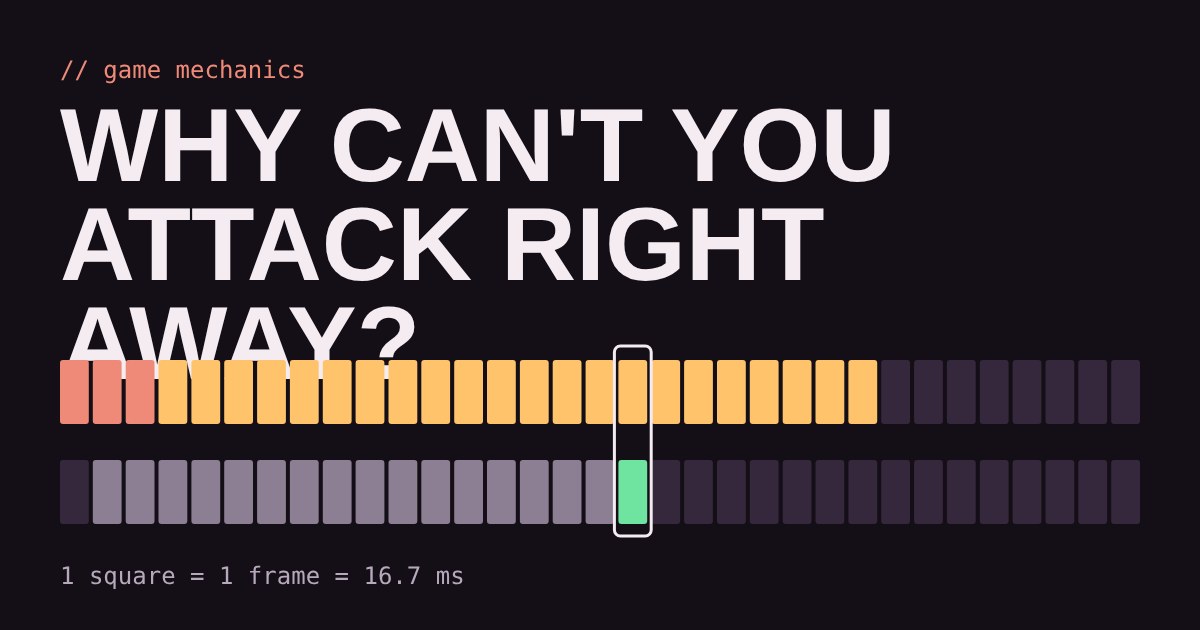
You press a button and your character swings. Nothing happens for a moment, then the hit comes out, then your character has to pull the swing back before you can do anything else. Those three phases are the heart of fighting games, and players count them in frames.
What is a frame?
Most fighting games run at 60 frames per second. One frame is therefore about 1/60 of a second, or 16.7 milliseconds. A move that takes 10 frames to hit takes about a sixth of a second. That sounds instant, but it is plenty of time for an opponent to react, block or hit you first.
Because the game updates in whole frames, designers can describe every move exactly with a few small numbers. Those numbers are called frame data, and most games publish them or show them in a training mode.
The three phases of every move
Startup is the number of frames before the move can hit. A 4-frame jab is fast; a 14-frame heavy swing is slow and easy to see coming. Active frames are the frames where the move can actually hit. Recovery is what comes after: your character is stuck finishing the animation and cannot block or attack.
Recovery is the price of a move. A powerful attack usually has long startup, long recovery, or both. A safe, quick attack does little damage. That trade is the basic balance of the genre.
Advantage: who gets to move first?
When an attack is blocked, the defender is frozen for a number of frames (called blockstun), while the attacker is still finishing the move. Compare the two and you get frame advantage, written as a plus or minus number.
A plus number means the attacker recovers first and can keep pressing. A minus number means the defender recovers first. At -10, the defender is free ten frames earlier, so any move with 10 frames of startup or fewer lands before the attacker can block. That counter-attack is called a punish.
Why a "safe" move is not always safe
Ask a beginner why they keep getting hit after a big attack and the answer is usually this: the move was blocked, it had long recovery, and the opponent had a quick reply ready. Try it in the lab above. The heavy swing looks scary, yet it is minus ten on block, so even a modest reply punishes it. The jab does little, but it is hard to punish.
The same maths explains why experienced players do not just press their biggest button. Fast moves keep you safe and keep the pressure on. Slow moves are a gamble that pays off only if they hit or the opponent is not ready.
How to use this in practice
You do not need to memorise every move. Open your game's training mode and turn on the frame data display, if it has one. Block a few of the opponent's big attacks and note which ones leave you with a long gap. Then find your own fastest move and check its startup. If its startup is not more than the gap, you can punish it.
Start with just two numbers: the startup of your fastest button, and how negative the opponent's big moves are on block. Everything else builds on those. If a move is unsafe, respond with something quick. If your own move is unsafe, use it less when the opponent is watching.
Frame data differs between games, and balance patches change numbers. Treat the figures in the lab as an illustration of the idea, not as the numbers from any specific game.
More in Game Mechanics
all Game Mechanics →31 Oct Why do abilities have cooldowns? Cooldowns, mana and stamina explained Why can't you spam your best move? Games limit abilities with cooldowns, mana or stamina, and each one gives a fight a different feel. Try… Game Mechanics
29 Oct Why do levels get slower? XP curves and level pacing explained Why do levels get slower the higher you go? Because the game charges more XP for each level, and that price list is called an XP curve… Game Mechanics
27 Oct What are weapon spread and recoil? Why your shots miss when you aimed right Why do bullets miss when your crosshair was right on target? Two different things are at work: spread, a random cone around your aim, and… Game Mechanics
25 Oct What is time to kill (TTK)? Why some shooters feel fast and others forgiving Why do some shooters feel lightning fast while others let you fight back? The answer is time to kill (TTK): how long a weapon needs to take… Game Mechanics
23 Oct Why does armor stop helping? Flat, percentage and diminishing returns explained Why does armor stop helping? Flat, percentage and diminishing returns are three different rules for turning an armor number into less… Game Mechanics
21 Oct How does matchmaking pick your opponents? Skill ratings and Elo explained Matchmaking tries to give you a fair fight, and it does that with a skill number. Learn how the Elo idea turns two ratings into a win…