Why do abilities have cooldowns? Cooldowns, mana and stamina explained
Why can't you spam your best move? Games limit abilities with cooldowns, mana or stamina, and each one gives a fight a different feel.
Try the live demo to see steady rhythm, burst-then-starve and risky trade-offs, then learn how to read the bars in any new game.
Why can't you spam your best move?
If your strongest attack had no limit, you would press it forever and every fight would look the same. So games put a brake on it. The brake decides how a fight feels: steady, bursty, or tense. There are three common brakes, and once you can spot them you will understand why one game rewards patience while another rewards panic.
The three brakes
A cooldown is a timer. You use the ability, then it is locked for a set number of seconds. Nothing else matters: you just wait. Cooldowns create a rhythm, and players learn to plan around it ("my big move is back in eight seconds").
A resource pool, usually called mana or energy, is a tank that every use drains and time slowly refills. You can spend it all at once for a burst of power, but then you are stuck waiting while it trickles back. Many fantasy and team-fight games use mana, and some combine it with cooldowns.
Stamina is a pool shared by several actions, such as attacking, blocking and dodging. Spending it on one thing means you have less for another. That is why stamina shows up in games about careful, risky fights: you are always choosing between hitting now and keeping enough in reserve to escape.
Burst or rhythm?
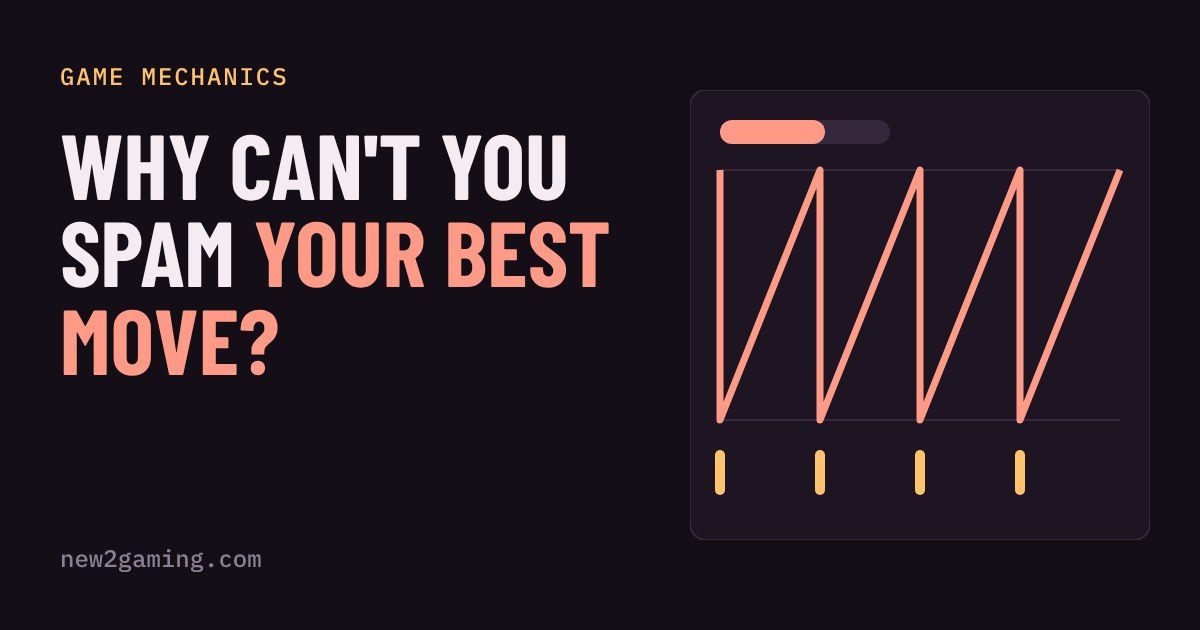
Try the sliders. On Cooldown, the line on the chart is a clean sawtooth and the ticks are evenly spaced. Every cast comes out the same, so the fight has a beat.
Switch to Mana. At the start you can cast several times in a row, because the pool is full. Then it runs dry and the ticks spread out to match the refill speed. That is the burst-then-starve shape: strong openings, weak middles. Make the refill faster and the gap shrinks; make each cast cost more and the burst gets shorter.
Now try Stamina. Here the refill only starts after a short pause, so spamming makes things worse, not just slower. In a real game you would also spend stamina on dodging, so every attack you throw is a dodge you may not have later.
Why designers pick one over another
Cooldowns are easy to read. Players can see the timer, so they know exactly when they are safe, and designers can balance a move by changing one number. The downside is that the ability feels the same whether you are in trouble or winning.
Resource pools add decisions. Spend it all now, or save some? That makes a fight more interesting, but it also makes it harder for a beginner to judge how much to hold back.
Stamina turns every action into a trade. It slows fights down and makes each swing feel meaningful, which is why it suits games where one mistake is costly.
What this means when you play
When you start a new game, look for the little bars and icons around your character. Ask which brake each one is. A greyed-out icon with a number is a cooldown: wait it out and plan around it. A coloured bar that drains is a pool: you can spend it, but think about what you need next. If your attacks, blocks and dodges all share one bar, it is stamina: keep a little in reserve.
The most common beginner mistake is spending everything at the start of a fight. If you know a limit exists, ask what you will do when it runs out.
More in Game Mechanics
all Game Mechanics →29 Oct Why do levels get slower? XP curves and level pacing explained Why do levels get slower the higher you go? Because the game charges more XP for each level, and that price list is called an XP curve… Game Mechanics
27 Oct What are weapon spread and recoil? Why your shots miss when you aimed right Why do bullets miss when your crosshair was right on target? Two different things are at work: spread, a random cone around your aim, and… Game Mechanics
25 Oct What is time to kill (TTK)? Why some shooters feel fast and others forgiving Why do some shooters feel lightning fast while others let you fight back? The answer is time to kill (TTK): how long a weapon needs to take… Game Mechanics
23 Oct Why does armor stop helping? Flat, percentage and diminishing returns explained Why does armor stop helping? Flat, percentage and diminishing returns are three different rules for turning an armor number into less… Game Mechanics
21 Oct How does matchmaking pick your opponents? Skill ratings and Elo explained Matchmaking tries to give you a fair fight, and it does that with a skill number. Learn how the Elo idea turns two ratings into a win… Game Mechanics
19 Oct What is a hitbox? Why some shots miss even when they look good Every character in a game has an invisible shape that decides whether a shot lands, and it is much simpler than the model you see. This…