What are weapon spread and recoil? Why your shots miss when you aimed right
Why do bullets miss when your crosshair was right on target? Two different things are at work: spread, a random cone around your aim, and recoil, a push that moves your aim with every shot.
Try a small interactive gun range to see the difference. Recoil patterns repeat and can be countered by pulling down; random spread can't, so the trick is to fire in short, paced bursts.
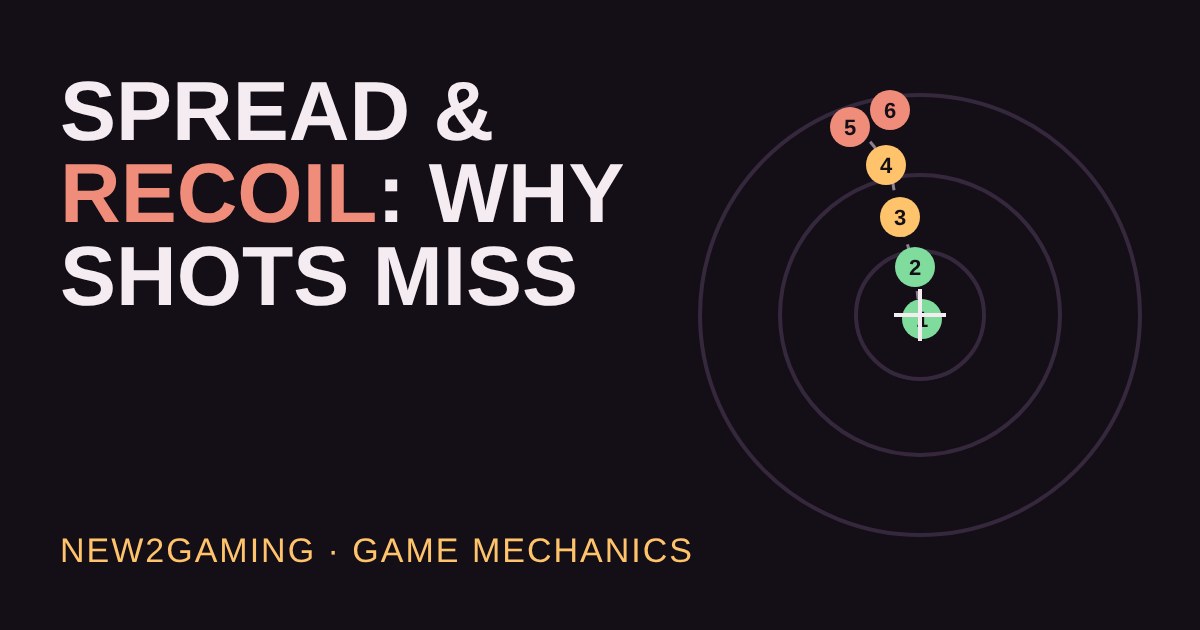
You line up the crosshair on an enemy's head, hold the trigger, and the bullets go everywhere except where you aimed. It feels unfair the first time. It is actually the game doing something on purpose: weapon spread and recoil are two of the main ways shooters make guns feel different from each other.
They sound alike but they are different ideas. Once you can tell them apart, you know what you can learn, what you can only manage, and why the best advice is often "stop holding the trigger".
Spread: the dice roll
Spread (also called bloom or inaccuracy) means a bullet does not go exactly where the crosshair points. The game picks a random spot inside a cone around your aim. A wider cone means shots land further from the centre, and because it is random, two bursts never look the same.
Games usually widen that cone when you do something hasty: moving, jumping, firing many shots in a row, or shooting from the hip instead of aiming down sights. They shrink it when you stand still, crouch or tap the trigger and wait. That is why "stop, then shoot" is such common advice. You are not being slow, you are shrinking the dice.
Recoil: the push
Recoil is the kick. Each shot pushes your aim in some direction, usually up, often with a sideways wobble. Unlike spread, recoil is often the same every time. Many shooters give each gun a fixed recoil pattern, so the first shots climb, then the gun sways left and right in a repeating shape. Counter-Strike players call this the spray pattern, and learning it is a big part of mastering a weapon.
That gives you a simple rule of thumb. Recoil can be learned and countered by pulling your aim the opposite way as you fire. Spread can only be managed, by firing in a way that keeps the cone small.
What the demo shows
Start with Fixed recoil pattern and press hold fire. The dots climb and then drift sideways, and every run repeats almost exactly. Now switch on "Pull down to counter" and fire again: the dots collapse into a tight group. That is what a player does when they "learn the spray". Real games add a little randomness on top, which the demo includes as a small wobble.
Switch to Random spread and hold fire. The dots scatter in a widening cloud, and the counter switch does nothing. There is no pattern to learn, because each shot is its own dice roll. Try the tap fire button instead and the cloud stays small. Slow, paced shots give the cone time to shrink.
Drag the gun strength slider to feel the difference between a gentle weapon and a wild one. Games tune this number to give each gun a role: a light rifle that is forgiving, a heavy one that rewards patience.
Why games do this at all
If every bullet went exactly where you aimed, the only skill would be placing the crosshair, and every gun would feel like the same laser pointer. Recoil and spread add decisions: do I fire a long burst up close, or tap from range? Do I move now or stand still for an accurate shot? They also make powerful guns costly to use, so a gun that does huge damage often has a harsher kick or wider cone to balance it. The same logic is behind the damage and fire-rate trade-offs in time to kill discussions.
It also explains something confusing for new players: two shooters can both have "recoil" and still feel nothing alike. One has a fixed pattern you can memorise. Another uses mostly random spread, so you mainly manage when you shoot. A third mixes both.
What to do as a beginner
You do not need to memorise patterns on day one. A few habits cover most of it:
- Burst, don't hold. Fire two to four shots, pause, repeat. This keeps both spread and recoil small in nearly every shooter.
- Stop before you shoot. Moving usually widens spread. Even a half-second pause helps.
- Aim down sights for distance. Hip fire is usually less accurate, which is the trade-off for speed up close.
- Use the practice range. Many games have one. Spray at a wall and watch the shape. If it repeats, it is a pattern you can learn. If it scatters, focus on bursts.
- Check the settings. Some games let you tweak the crosshair, add recoil shake or show bullet spread. A clear crosshair makes the cone easier to read.
Last point: when shots miss, it is worth knowing whether the game caused it (spread or recoil) or whether it was a server matter such as lag. Those are different problems, and only the first is fixed by changing how you fire.
More in Game Mechanics
all Game Mechanics →25 Oct What is time to kill (TTK)? Why some shooters feel fast and others forgiving Why do some shooters feel lightning fast while others let you fight back? The answer is time to kill (TTK): how long a weapon needs to take… Game Mechanics
23 Oct Why does armor stop helping? Flat, percentage and diminishing returns explained Why does armor stop helping? Flat, percentage and diminishing returns are three different rules for turning an armor number into less… Game Mechanics
21 Oct How does matchmaking pick your opponents? Skill ratings and Elo explained Matchmaking tries to give you a fair fight, and it does that with a skill number. Learn how the Elo idea turns two ratings into a win… Game Mechanics
19 Oct What is a hitbox? Why some shots miss even when they look good Every character in a game has an invisible shape that decides whether a shot lands, and it is much simpler than the model you see. This… Game Mechanics
17 Oct What is rubber banding? Why racing game opponents always catch up Ever pulled far ahead in a racing game, only to find the computer cars right behind you a moment later? That is rubber banding: a hidden… Game Mechanics
15 Oct Is the loot drop rigged? RNG, drop rates and pity timers explained Ever gone ten drops in a row without the item you wanted? It feels rigged, but it is usually just random chance doing what it does. This…