Why do levels get slower? XP curves and level pacing explained
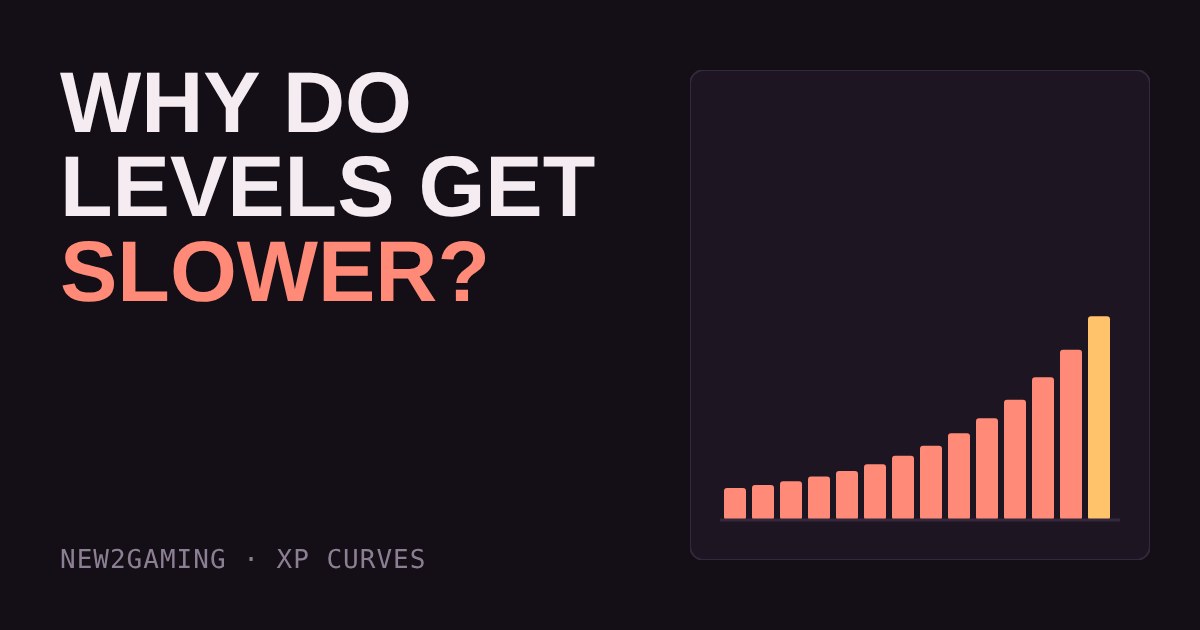
Why do levels get slower the higher you go? Because the game charges more XP for each level, and that price list is called an XP curve.
Learn the four common shapes (flat, linear, curved and exponential), why the payout matters as much as the price, and how to spot a wall before you hit it. Drag through an interactive chart to see how long each level really takes.
You reach level 5 in an evening. Level 30 takes a week. Level 50 feels like a second job. Nothing about you changed, so why does the game keep getting slower? The answer is a number table called an XP curve, and once you can read one, you can tell how long a game will really take before you commit to it.
XP needed per level
Almost every game with levels works the same way. You earn XP (experience points) from fights, quests or matches. Each level has a price in XP. When you have paid it, you level up and the next price is shown. The list of prices is the XP curve.
Designers pick the shape of that list on purpose. Four common shapes show up again and again:
- Flat: every level costs the same. Easy to understand, but levels feel like a treadmill and the early game is not any faster than the end.
- Linear: each level costs a little more than the last (level 1 costs 150, level 2 costs 300, and so on). Gentle and predictable.
- Curved (polynomial): costs grow faster and faster, but not explosively. A very common choice for long RPGs.
- Exponential: costs multiply every level. This one doubles roughly every 5 levels in the demo below, so late levels become enormous.
Cost is only half the story
A big price does not automatically mean a slow level. What matters is how long a level takes you, which is the price divided by how much XP you earn per hour. Most games raise your payout as you go: harder enemies give more XP, later quests pay out bigger rewards. If the payout grows as fast as the price, every level takes about the same time. If the price outruns the payout, you hit a wall.
That is why a steep curve can still feel fine in one game and brutal in another. Compare the cost and the payout, not just the cost.
Why designers slow you down on purpose
Slowing down the late game is not laziness. A steep curve does real jobs. It makes early levels fast, so new players get a quick taste of progress. It stretches the long tail so dedicated players have something to chase. And it keeps the level cap meaningful, because if levels never got slower, everyone would hit the top in a week.
The risk is the wall. When the cost of a level grows faster than your payout, the game stops feeling like progress and starts feeling like waiting. Many games soften this with catch-up XP (bonus XP for low levels), rested or boosted XP after a break, or XP events that temporarily raise your payout.
Level numbers are not comparable between games
"Level 100" means nothing on its own. One game might reach it in 20 hours, another in 2,000. What matters is the shape of the curve and what each level actually gives you. A level that unlocks a new ability is worth more than one that adds 1% damage. Be careful with player claims like "it only takes a weekend to max out" unless you know how the curve and payout are set up in that particular game.
What to look for
When you read about a game's progression, check these four things:
- Hours to the cap: a rough number from players, not the level number itself.
- Whether payouts scale: do later enemies and quests give much more XP, or the same?
- Where the wall is: many games have one level range where the pace changes sharply.
- Catch-up and boosts: rested XP, bonus weekends, or shortcuts that help a late start.
With those four in hand you can guess how a game will feel long before you spend your first hour in it.
More in Game Mechanics
all Game Mechanics →27 Oct What are weapon spread and recoil? Why your shots miss when you aimed right Why do bullets miss when your crosshair was right on target? Two different things are at work: spread, a random cone around your aim, and… Game Mechanics
25 Oct What is time to kill (TTK)? Why some shooters feel fast and others forgiving Why do some shooters feel lightning fast while others let you fight back? The answer is time to kill (TTK): how long a weapon needs to take… Game Mechanics
23 Oct Why does armor stop helping? Flat, percentage and diminishing returns explained Why does armor stop helping? Flat, percentage and diminishing returns are three different rules for turning an armor number into less… Game Mechanics
21 Oct How does matchmaking pick your opponents? Skill ratings and Elo explained Matchmaking tries to give you a fair fight, and it does that with a skill number. Learn how the Elo idea turns two ratings into a win… Game Mechanics
19 Oct What is a hitbox? Why some shots miss even when they look good Every character in a game has an invisible shape that decides whether a shot lands, and it is much simpler than the model you see. This… Game Mechanics
17 Oct What is rubber banding? Why racing game opponents always catch up Ever pulled far ahead in a racing game, only to find the computer cars right behind you a moment later? That is rubber banding: a hidden…