Why does armor stop helping? Flat, percentage and diminishing returns explained
Why does armor stop helping? Flat, percentage and diminishing returns are three different rules for turning an armor number into less damage taken, and each one has its own wall.
Play with all three on one chart, see where each one runs out, and learn what to build against many small hits, rare big hits and capped armor.
What armor actually does
In many games, armor is a number on your character sheet that makes hits hurt less. The tricky part is that the number does not mean the same thing everywhere. A "50 armor" in one game can cut damage in half. In another it might remove 50 points from every hit. In a third it might do something in between.
Game designers pick one of three main rules to turn armor into damage. Knowing which rule a game uses tells you what to build, what to ignore, and why stacking armor sometimes stops helping.
Rule 1: flat reduction
With flat reduction, armor is subtracted from every hit. If a hit does 100 damage and you have 30 armor, you take 70. Simple, and easy to read at a glance.
The catch: flat armor is brilliant against many small hits and weak against one big hit. A fast, weak attacker gets almost nothing through, while a slow heavy hitter barely notices your armor. Taken far enough, flat armor can cancel a hit completely, so games usually add a minimum damage rule (often 1) so nothing becomes untouchable.
Rule 2: percentage reduction
With percentage reduction, armor removes a share of every hit. 40 armor might mean you take 40% less damage, no matter how big the hit is. It treats small and big hits the same way, which is why it feels fair.
The catch: if you can keep adding armor, you would eventually reach 100% and take nothing. Games stop that with a hard cap, such as "armor stops helping at 75% reduction". Past the cap, extra armor is wasted.
Rule 3: diminishing returns
The third rule is the one many competitive games use. Damage taken is multiplied by 100 / (100 + armor). At 0 armor you take full damage. At 100 armor you take half. At 200 armor you take a third. Each extra point still helps, but a little less than the one before, and you never quite reach zero.
League of Legends documents its physical armor this way. Dota 2 uses a related formula with a different scale. The idea is the same: early armor is a big win, late armor is a small one.
There is a useful way to read it. Under this rule, every point of armor adds the same amount of effective health, which means how much raw damage you can soak before you drop. 100 armor doubles your effective health, 200 armor triples it. The "percent reduced" figure looks like it is flattening, but the effective health keeps growing in a straight line.
Try the three rules
Set an armor value and a hit size. The chart shows how much of a hit gets through at each armor level. The cards show what happens to a 1000-health character under each rule.
What the chart shows
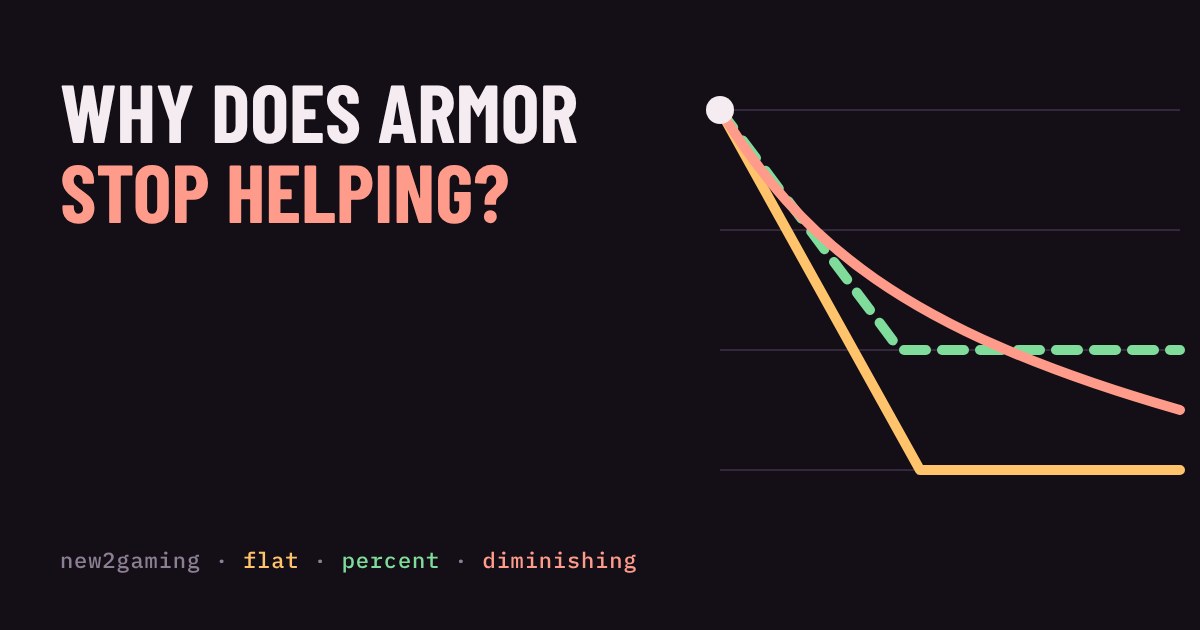
The orange line, flat reduction, falls in a straight line and then sits on the minimum-damage floor. At 100 hit size it hits the minimum around 200 armor. The green dashed line, percentage reduction, falls in a straight line and then stops dead at the cap. The coral line, diminishing returns, bends gently and never touches zero.
Pay attention to the first 50 armor. All three rules give you a big drop there. The difference shows up later, which is where players waste points.
What to remember when you build a character
Before you stack armor, find out which rule your game uses. The game's wiki, patch notes or in-game tooltip usually spell it out. Then use this checklist:
Against many small hits (fast attackers, damage over time, swarms), flat armor is gold and the percentage rules are fine.
Against rare big hits (bosses, snipers, heavy attacks), flat armor does little. Look for percentage reduction, extra health or shields instead.
Near a cap, stop. Spend the next point on something else, like health or speed.
With diminishing returns, the first points are the best value. If you already have a lot, a point of health often beats a point of armor, and the reverse is true when you have little armor.
One last note: armor often covers only one damage type, such as physical damage. Magic, fire or "true" damage may ignore it, so armor alone never makes you safe.
More in Game Mechanics
all Game Mechanics →21 Oct How does matchmaking pick your opponents? Skill ratings and Elo explained Matchmaking tries to give you a fair fight, and it does that with a skill number. Learn how the Elo idea turns two ratings into a win… Game Mechanics
19 Oct What is a hitbox? Why some shots miss even when they look good Every character in a game has an invisible shape that decides whether a shot lands, and it is much simpler than the model you see. This… Game Mechanics
17 Oct What is rubber banding? Why racing game opponents always catch up Ever pulled far ahead in a racing game, only to find the computer cars right behind you a moment later? That is rubber banding: a hidden… Game Mechanics
15 Oct Is the loot drop rigged? RNG, drop rates and pity timers explained Ever gone ten drops in a row without the item you wanted? It feels rigged, but it is usually just random chance doing what it does. This… Game Mechanics
13 Oct What is aim assist? How games help controller players aim Aim assist is the small, hidden help that shooters give controller players: the crosshair slows down near an enemy, and the view quietly… Game Mechanics
11 Oct Delay or rollback? How online games hide lag: netcode explained Online games have to keep two computers in agreement while messages take time to travel. Delay-based netcode waits for both players'…