How does matchmaking pick your opponents? Skill ratings and Elo explained
Matchmaking tries to give you a fair fight, and it does that with a skill number. Learn how the Elo idea turns two ratings into a win chance, then play with a live demo to see why upsets move your rating more than expected wins.
Find out why real games add more on top, and what that means when a match feels unfair.
What matchmaking is trying to do
When you press "Find match", a system has a simple job: put you in a game where the result is not decided before it starts. If you are placed against much stronger players you lose and learn little. Against much weaker players you win and learn little. The sweet spot is a match where both sides have a fair chance, and for many games that means roughly a coin flip.
To aim for that, the game needs a number for how good you are. That number goes by many names: rating, rank points, MMR (matchmaking rating) or skill. Most of them descend from one old idea.
The Elo idea in one minute
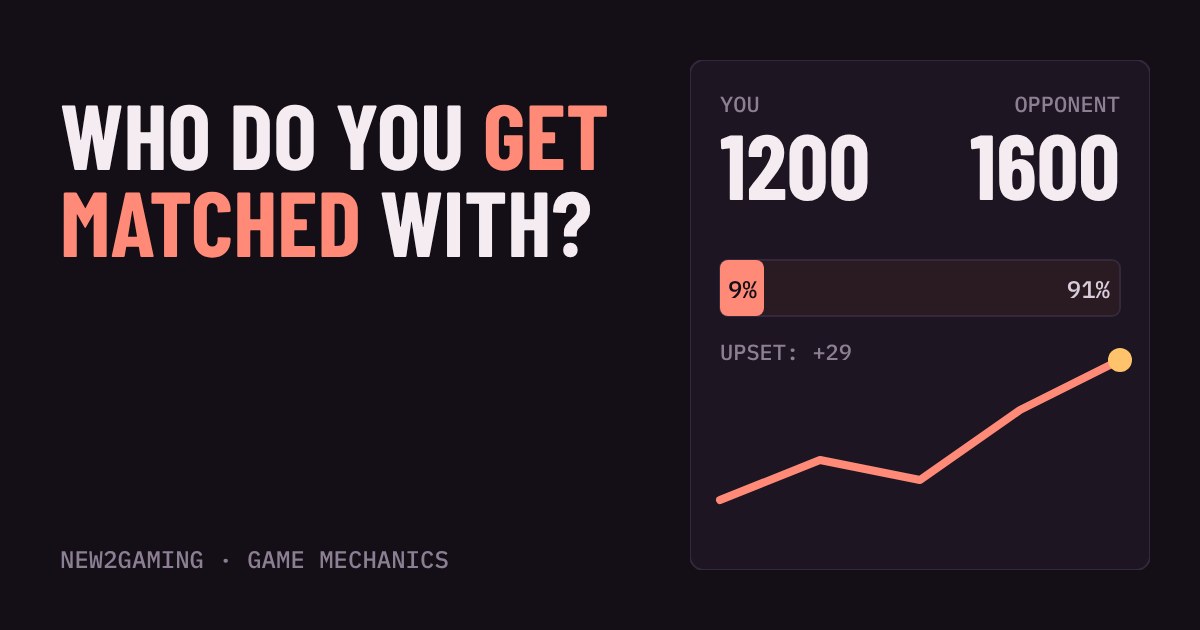
The Elo system was designed by Arpad Elo for chess. Every player has a rating. Before a match, the system compares two ratings and turns the gap into a win chance. The classic formula treats a 400-point gap as roughly 10-to-1 odds in favour of the higher player, which is about a 91% win chance. A 200-point gap is about 76%, and a 100-point gap is about 64%.
After the match, ratings move. The size of the move depends on how surprising the result was. If the favourite wins, they gain a little. If the underdog wins, they gain a lot, and the loser drops a lot. A setting called the K-factor scales how big the moves are: a high K reacts fast, a low K is steady. A K of 32 is a common textbook example, and it is what the demo below uses.
Try it. Set the two ratings, then play matches and watch the numbers.
What you just saw
Two patterns are worth noticing. First, the system is self-correcting: if you keep beating players rated higher than you, your rating climbs until the opponents it picks for you are about your level. Press "Play by the odds" a few dozen times with equal ratings and your line wanders around the middle, because wins and losses cancel out.
Second, the moves are zero-sum in this basic version: what you gain, your opponent loses. That is why you can feel "stuck" when your results are roughly even. Even results mean you are being matched about right.
Why real games are more complicated
Plain Elo was built for one-on-one games. Online games need more, and most use a descendant of it. Some track how sure they are about your rating, so a brand-new account moves fast and a veteran moves slowly; Glicko is a well-known system built on that idea. Others, like Microsoft's TrueSkill, were designed to rate players in teams and with more than two sides. Many games also add hidden tweaks of their own, which they rarely publish in detail.
Matchmaking also has to balance more than skill. Searching for a perfectly even match can mean a long wait, so most systems loosen the allowed gap the longer you queue. Your connection quality, the region you are in, and the time of day all push on the result too. A short queue and a fair game are in tension, and every game picks its own compromise.
Visible rank versus hidden rating
Many games show you a rank (a tier, a division, stars) that is separate from the hidden number used to pick opponents. The visible rank is designed to feel rewarding, so it may move in steps or protect you from drops. Do not assume the two are identical. When a game tells you how it works, trust that over a guess from outside.
What to do with this
If your matches feel unfair, a few things are worth knowing before you blame the system. Losing streaks happen even at a fair 50% win chance, much more often than most people expect. A new account is rated with less certainty, so early games can be lopsided. And playing in a party or at odd hours can change who you are matched with. If you want to improve, the useful signal is your trend over dozens of matches, not any single result.
More in Game Mechanics
all Game Mechanics →19 Oct What is a hitbox? Why some shots miss even when they look good Every character in a game has an invisible shape that decides whether a shot lands, and it is much simpler than the model you see. This… Game Mechanics
17 Oct What is rubber banding? Why racing game opponents always catch up Ever pulled far ahead in a racing game, only to find the computer cars right behind you a moment later? That is rubber banding: a hidden… Game Mechanics
15 Oct Is the loot drop rigged? RNG, drop rates and pity timers explained Ever gone ten drops in a row without the item you wanted? It feels rigged, but it is usually just random chance doing what it does. This… Game Mechanics
13 Oct What is aim assist? How games help controller players aim Aim assist is the small, hidden help that shooters give controller players: the crosshair slows down near an enemy, and the view quietly… Game Mechanics
11 Oct Delay or rollback? How online games hide lag: netcode explained Online games have to keep two computers in agreement while messages take time to travel. Delay-based netcode waits for both players'… Game Mechanics
9 Oct Why does 60 FPS still feel choppy? Frame time and stutter explained Your game says 60 FPS but still feels choppy? The counter shows an average. What your eyes notice is frame time, the gap between each…