What is time to kill (TTK)? Why some shooters feel fast and others forgiving
Why do some shooters feel lightning fast while others let you fight back? The answer is time to kill (TTK): how long a weapon needs to take a target from full health to zero.
Build your own example weapon with sliders, switch between body shots and headshots, and watch each hit land on a timeline against a typical reaction time. Learn the simple formula, why one extra point of damage can remove a whole shot, and how to read a new game's pace.
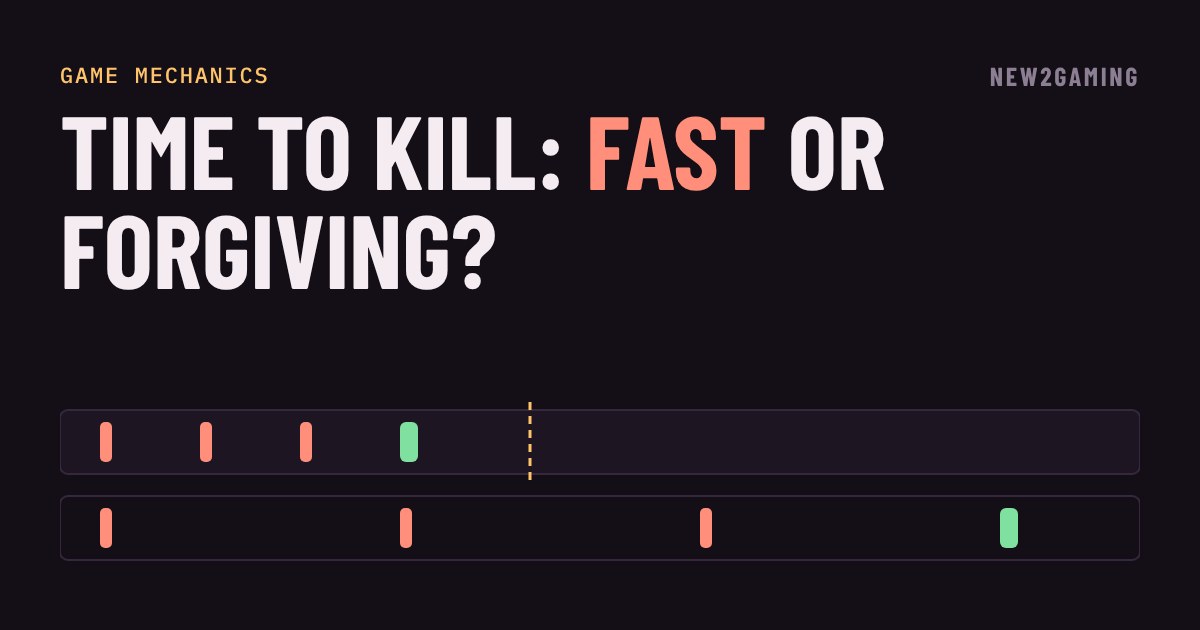
You land your shots, and still lose the fight. Or you get deleted before you can react. Both feelings come from one hidden number: time to kill, usually shortened to TTK. It is how long a weapon needs to take a target from full health to zero.
What TTK actually measures
TTK starts when your first shot lands and stops when the last, killing shot lands. It is not the time before you fire, and it is not the time you spend aiming. It is only the gap between the first hit and the final hit.
That is why the first shot is "free". If a weapon needs 4 hits, the clock only runs over the 3 gaps between them. The formula is short:
TTK = (hits needed − 1) × time between shots
And the two ingredients are easy to find. Hits needed is the target's health divided by damage per hit, rounded up. Time between shots comes from the fire rate, which games usually list in rounds per minute (RPM): divide 60,000 by the RPM to get milliseconds per shot. A weapon firing 600 RPM shoots every 100 ms.
Try it: build a weapon and watch the clock
Change the numbers below. The bar shows each shot landing on the timeline, and the readout shows the TTK. The weapons are made-up examples, not any specific game.
Why the same damage can feel different
Try the Fast SMG and the Slow cannon. The SMG hits for little but fires fast; the cannon hits hard once a second. Their TTKs can end up close, yet they feel nothing alike. Small, frequent hits make the fight about tracking: keeping your aim on a moving target. A single big hit makes it about timing and positioning.
Remember the rounding too. Health 100 with 30 damage needs 4 hits, but 34 damage needs only 3. One extra point of damage can remove a whole shot from the fight. That is why designers tune weapon damage in tiny steps, and why a small balance patch can change how a game feels.
Short TTK or long TTK?
Neither is better. They create different games.
Short TTK
Kills happen in a blink. The player who sees the other first and shoots first usually wins, so these games reward quick reactions, sound awareness and careful positioning. Mistakes are punished hard, and the pace feels tense.
Long TTK
Fights last long enough to dodge, take cover, use abilities and come back from a bad start. The player who aims better over time wins more often. These games feel more forgiving, and they leave room for teamwork and special powers.
Two things stretch or shrink TTK in practice. Armor and shields add effective health, so hits needed goes up. Headshot multipliers do the opposite: flip the toggle in the demo to see the same weapon kill in far fewer hits. If you read about "bullet sponge" enemies, that is simply a very long TTK on purpose.
Why your own TTK is not the listed one
The number in a weapon table is the best case: every shot hits, at full health, with no armor. Real fights add misses, distance (many weapons lose damage over range), movement, and lag between your screen and the server. A weapon that looks fast on paper can feel slow if half your shots miss. When a game seems to kill you "too fast", compare its TTK with how long you actually had to react.
What to look for when you try a new shooter
Skip the exact numbers and watch for a few signs in your first matches:
Do you often die before you can react? Then TTK is short: slow down, check corners, and use sound. Do fights drag on and swing back and forth? Then TTK is long: use cover, retreat to heal and keep your aim steady. Does one weapon feel much faster than the rest? Look at its fire rate and hits needed, not just its damage number. That tells you whether to fight up close or from range.
More in Game Mechanics
all Game Mechanics →23 Oct Why does armor stop helping? Flat, percentage and diminishing returns explained Why does armor stop helping? Flat, percentage and diminishing returns are three different rules for turning an armor number into less… Game Mechanics
21 Oct How does matchmaking pick your opponents? Skill ratings and Elo explained Matchmaking tries to give you a fair fight, and it does that with a skill number. Learn how the Elo idea turns two ratings into a win… Game Mechanics
19 Oct What is a hitbox? Why some shots miss even when they look good Every character in a game has an invisible shape that decides whether a shot lands, and it is much simpler than the model you see. This… Game Mechanics
17 Oct What is rubber banding? Why racing game opponents always catch up Ever pulled far ahead in a racing game, only to find the computer cars right behind you a moment later? That is rubber banding: a hidden… Game Mechanics
15 Oct Is the loot drop rigged? RNG, drop rates and pity timers explained Ever gone ten drops in a row without the item you wanted? It feels rigged, but it is usually just random chance doing what it does. This… Game Mechanics
13 Oct What is aim assist? How games help controller players aim Aim assist is the small, hidden help that shooters give controller players: the crosshair slows down near an enemy, and the view quietly…