Why is it so hard to stop playing? Streaks, daily rewards and the one-more-match trap
Many games are built with no natural place to stop, which is why "ten more minutes" so often turns into an argument. This guide explains three common hooks, streaks, daily rewards and timers, and the "one more match" loop, and lets you try a streak calendar under a harsh rule and a kinder one.
You will also get five simple ways to make stopping easier, from agreeing a stopping point first to naming the hook out loud with your child.
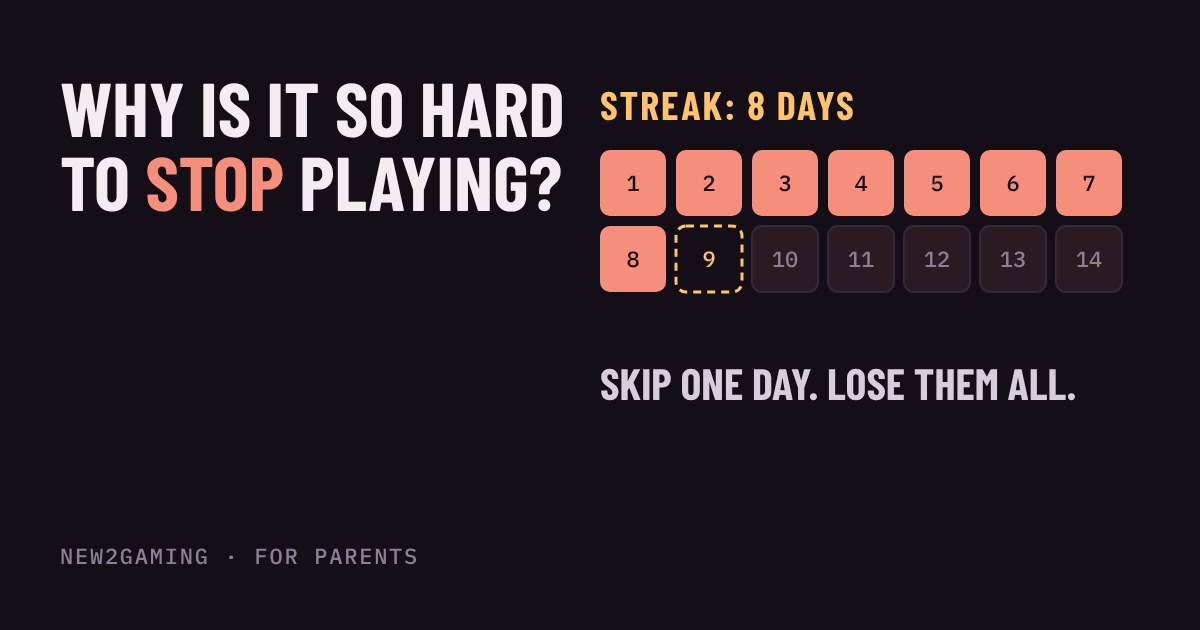
Why is it so hard to stop?
You say "ten more minutes" and your child says "okay", then the timer runs out and suddenly it is a crisis. Before you decide it is a discipline problem, look at the game itself. Many games are built, on purpose, so that there is never a natural place to stop. That is a design choice, and once you can see it, you can plan around it.
This guide is not about whether games are good or bad. It is about three common hooks, how they work, and what to say or change so stopping gets easier.
Hook 1: the streak
A streak counts how many days in a row you have played, logged in or finished a daily task. The longer it gets, the more you have to lose. After a week, skipping a day does not feel like "missing a game". It feels like throwing away a week.
That is why a streak can push a child to play when they are tired, ill or on holiday. The game has turned a hobby into a chore with a penalty. Try it below: tap the days to play or skip them, and flip the rule to see how the same calendar feels under a harsh design and a kinder one.
Hook 2: the daily reward and the timer
A daily reward gives you something small for opening the game, and the prizes often get better each day. A timer does the reverse: a chest, a crop or an energy bar is "ready" in some hours, so there is always a reason to come back and check.
Neither one needs you to play for long. They need you to show up. For a child that can mean a quick login at school, at dinner or at 6 a.m., because something is waiting. If you see a child checking a game over and over without really playing it, this is usually why.
Hook 3: "one more match"
Some games put the next round on screen before the last one has finished. A new level loads, a queue starts automatically, or a progress bar sits just short of the next unlock. Each round ends in a way that makes the next one feel like it is already half done.
Compare that with a book chapter or a football match, which ends. A game that never ends needs you to supply the stopping point. Children, especially younger ones, are not yet good at that, and many adults are not either.
What to do about it
Agree the stopping point before you start
"Ten more minutes" is vague. "We stop after this match" or "after this level" is a place in the game, which is much easier to keep. Ask your child what the game's next natural end is, and use that.
Warn early, then give a short wind-down
Give a heads-up while there is still time to finish something, not at the moment you need the console off. Leave a few minutes at the end to save, say goodbye to friends in a team game and reach a safe spot.
Name the hook out loud
Children are quick to spot when they are being steered. "That streak counter wants you to log in every day. Do you want it to decide that for you?" turns a fight with you into a joke at the game's expense. It also builds a habit that will help them with every app they use.
Look for the off switch
Notifications and reminders are often the part that pulls a child back in. Most consoles and phones let you turn them off or silence them at set times, and many games let you opt out of "come back" messages. Settings differ between games, so check the game's own menu as well as the device.
Choose games that end
Games with levels, chapters, a story or a clear match length are easier to stop than endless ones. That does not make endless games off limits. It just means you will need to set the stopping point yourself.
When it is more than a habit
Almost every child will complain when the screen goes off. That alone is normal. It is worth talking to a doctor or school counsellor if a child regularly misses sleep, meals or school because of gaming, loses interest in everything else, or becomes very distressed when they cannot play. A professional can help you work out what is going on, and you do not need to wait for a crisis.
More in Parents
all Parents →25 Oct Do gaming breaks matter? Eyes, posture and the 20-20-20 rule for kids Do long gaming sessions strain your child's eyes and back? Screens can leave eyes dry and tired because we blink less while focusing, and a… Parents
23 Oct What do game age ratings mean? PEGI, ESRB and what they leave out An age rating tells you what a game contains, not how hard it is or who you'll meet online. PEGI and ESRB use different age steps, but both… Parents
21 Oct How do you spot a gaming scam? Free skins, fake logins and the four red flags Gaming scams target kids with free currency, fake "account security" emails and strangers who want a login code. They all pull the same… Parents
19 Oct How much gaming is too much? Build a screen-time plan that fits the day There is no single right number of gaming hours, because what matters is what the gaming pushes out. This guide shows a simple order of… Parents
17 Oct Which parental controls should you switch on first? A setup planner by age Every console has parental controls, but the menus are long and confusing. This guide boils them down to four switches: time, spending… Parents
15 Oct How much does in-game currency really cost? Gems, packs and spending limits Games sell extras with made-up currency, and packs rarely match item prices, so leftovers nudge you to buy more. Try a mock shop to see the…