What does 'day one' mean on a game subscription? Launch day, a year later or never
Is the new game you want on your subscription the day it launches? Sometimes yes, often a year later, and sometimes never. This guide explains what *day one* means, how Game Pass and PS Plus treat their own games, Call of Duty and smaller indie titles differently, and why the biggest releases tend to wait.
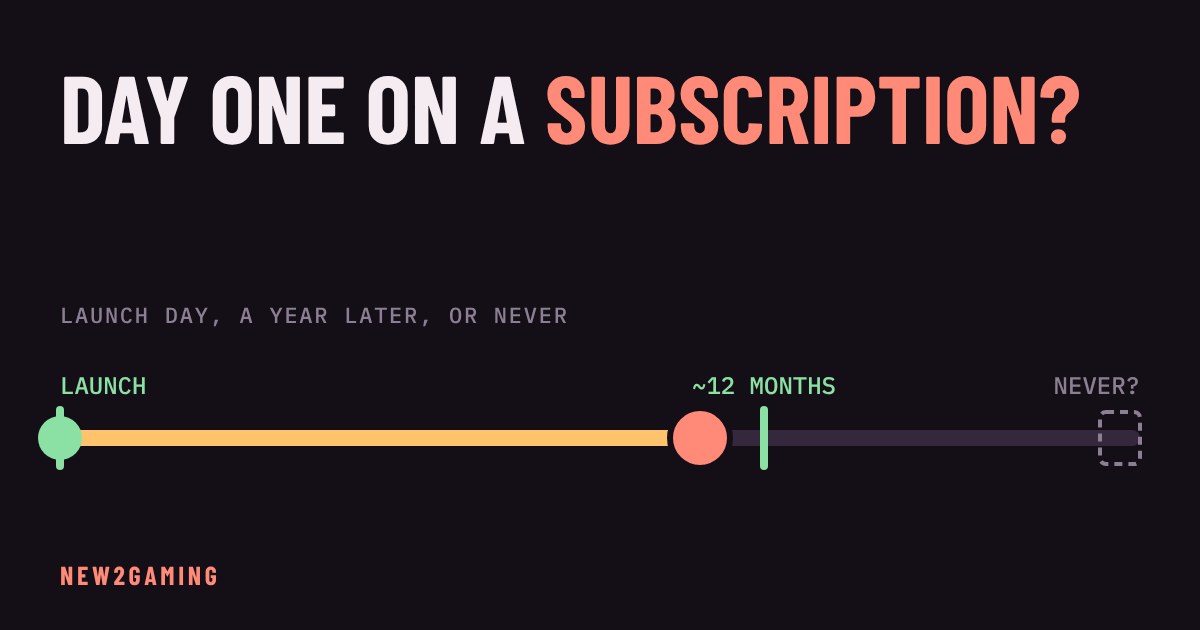
Drag the handle in the interactive to see how long you would have to wait for each kind of game, and learn the one question to ask before you pay for a plan.
You see a big new game announced and think: "Can I just play it on my subscription?" The answer depends on one phrase most beginners have never heard: day one. It means a game is added to the service on the same day it is released. Some games are. Many aren't, and a few never will be.
What "day one" really means
A subscription library is not one pile of games that all behave the same. Each game has its own arrival date on the service, and that date can be launch day, about a year later, or never. If you subscribe for a game that arrives a year after release, you pay for months of other things while you wait.
The fastest way to see this is to try it. Pick a service, pick the kind of game you want, then drag the handle to how long you are willing to wait.
The three patterns
Day one. The game appears in the library the moment it launches. This is the best case for a subscription: you pay a monthly fee instead of the full price of the game. Microsoft has been the main service to do this with its own studios' games, on its top plans.
Delayed. The game arrives months after launch, often around the one-year mark. Sony has said its own big games reach PS Plus at least a year after release. Microsoft's cheaper Premium plan works the same way for Xbox-made games, and in April 2026 Microsoft said new Call of Duty games would also move to roughly a year after launch instead of day one.
Sometimes. Smaller and third-party games are decided one by one. A few arrive on release day, most don't. Sony, for example, has said only a handful of smaller games join PS Plus on their release day each year.
Why services hold games back
Most of a big game's sales happen in the first months. A service that adds the game on day one gives up some of those sales, because people can play it without buying it. Holding it back for a year protects sales and still gives the library something to show later. That is why the biggest new releases are often the ones that wait.
It also explains why the day-one rules shift. Prices, plans and release rules are business choices, and they get changed. A rule that was true when you read a review last year may not be true today.
A quick way to decide
Ask one question before you pay: do I want to play this game this month? If yes, check whether it is a day-one release on the exact plan you would buy. A service's front page may say "new games every month" without saying which plan they are on. If it is not day one, buy the game, or add it to a wish list and wait.
If the answer is "someday", don't subscribe at all. Wait until the game shows up in the library, then pay for one month, play it, and cancel. Just remember that library games stop being playable when you cancel.
What to check on the plan page
Look for the words "day one" or "at launch" next to the exact plan you would buy, not just the service name. Check whether a game you care about has a stated exception, as Call of Duty now does on Game Pass. And check the date on the page: if the information is more than a few months old, look for something newer.
More in Subscriptions
all Subscriptions →26 Oct How much storage does a game subscription need? Install sizes, download time and data caps A game subscription gives you a big library, but most of those games still download onto your console or PC. That means two costs nobody… Subscriptions
24 Oct Will a free trial charge you? Auto-renew, trial deals and how to cancel in time Most game subscription trials turn into a paid plan unless you cancel. Learn how auto-renew works, why the last day is risky, and where to… Subscriptions
21 Oct Which 'free' games do you keep? What happens when you cancel a subscription Cancelling a game subscription stops the next charge, but what happens to your games depends on how you got them. Some are rented and lock… Subscriptions
19 Oct Can your internet handle cloud gaming? Speed, ping and Wi-Fi explained Cloud gaming streams the game to you as video, so your home internet becomes your console. Two numbers decide how it feels: speed, which… Subscriptions
17 Oct Do you need a subscription to play online? What's free and what's paywalled Do you really need to pay for PlayStation Plus, Game Pass or Nintendo Switch Online? It depends on what you play. On console, the… Subscriptions
15 Oct Is a game subscription cheaper than buying your games? A break-even calculator Is a game subscription cheaper than buying your games? It depends on three numbers: how many games you play, how many are in the catalog…