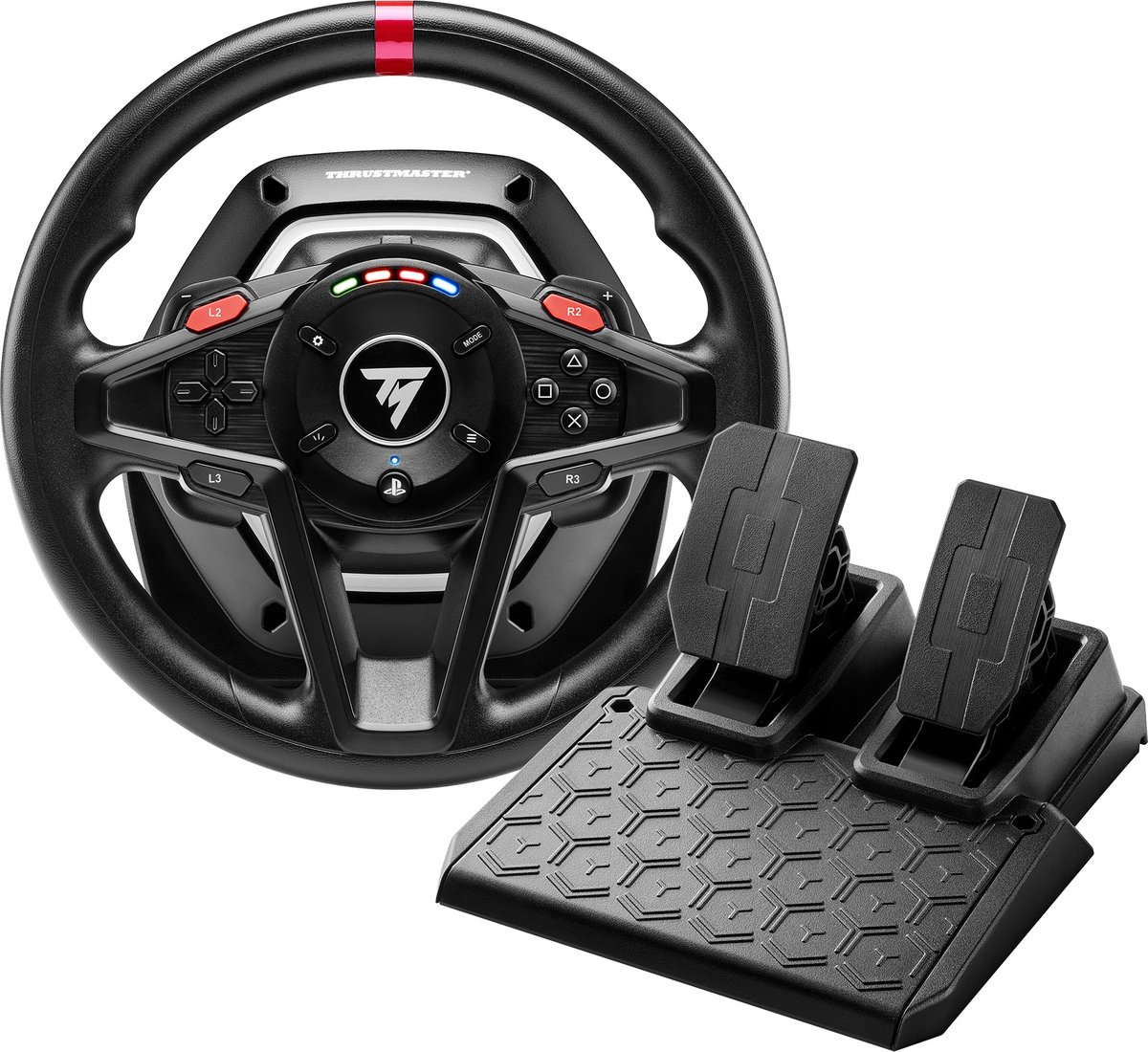
What a racing wheel is for
A controller steers with a thumb that moves a few millimetres. A racing wheel steers with your whole forearm, and a real car's wheel turns about two and a half times from one end to the other. That is the main thing a wheel adds: finer steering, plus pedals you press instead of triggers you squeeze. If you mostly play racing games, a wheel can make them feel very different. If you play one racing game a month, a controller is fine.
A wheel is also a bigger commitment than most accessories. It needs desk or table space, it has to be clamped or mounted, and it only helps in games that support it.
Check the platform first
This is where beginners get caught. A wheel is built for specific consoles, and the box says which ones. A wheel made for PlayStation will not work on Xbox, and the reverse. Some wheels list several platforms, but read the exact model name: the same brand often sells a PlayStation version and an Xbox version of the same wheel. Also check that your game supports wheels at all, and which models. Game pages and the game's controller settings list this.
Rotation: how far the wheel turns
Rotation is measured in degrees from lock to lock, meaning all the way left to all the way right. Cheap wheels turn about 270°, so a quarter turn already steers a lot. Better wheels turn 900° or more. Most games let you set the range, and many do it automatically to match a real car.
Try it below. Drag the wheel round, then let go.
On a 270° wheel the whole job is squeezed into a small arc, so a tiny movement is a big change and small corrections are twitchy. On a 900° wheel the same tyre angle needs a lot more turn, which feels slow at first and then precise. Neither is better in every game. Arcade racers suit short rotation, and cars that feel realistic suit a long one.
Force feedback: the wheel pushes back
Force feedback means a motor inside the wheel pulls against your hands. It makes the wheel return to centre, go heavy in a fast corner and shake over kerbs. The toggle above shows the simplest part of it: with feedback on, the wheel straightens itself when you let go. With it off, it stays where you left it, because nothing moves it. Cheaper wheels often only rumble, which tells you something is happening but does not push back. Feedback is the difference between steering and just pointing, and it is the main reason mid-priced wheels cost more than basic ones.
Motor strength is usually given in newton-metres. More is not automatically better for a beginner. A stronger wheel needs a firmer mount and can be tiring, so a gentle motor is fine to start on.
Pedals, paddles and mounting
Most wheels come with two pedals: accelerate and brake. Cheap pedal sets are light and slide on the floor. Look for a brake that has some resistance, because braking by feel is much easier when the pedal pushes back. A third pedal (the clutch) only matters if you want a manual gearbox with a separate shifter, and many beginners never use one. Paddles on the back of the wheel change gear, so you do not need a shifter.
Mounting matters more than people expect. A clamp that grips a sturdy desk works well. A wheel on a wobbly table moves when you turn, which ruins the feel. If you play on a sofa, check how you will hold the wheel and where the pedals will sit before you buy.
Is a wheel worth it for you?
Ask three questions. Do you play racing games often enough to use it every week? Do you have a table or desk you can clamp it to, and somewhere to store it? Does the game you love support wheels? If the answer to all three is yes, a wheel is a good purchase. If you are not sure, play on a controller for a few weeks first. You will quickly learn whether steering is the part of racing you want to improve.
What to look for
Under about €150, the things that matter are: it supports your console, it comes with pedals, and it clamps firmly. Expect a short rotation and little or no force feedback. Around €150–250, look for real force feedback, a wide rotation range (up to 900°) and paddle shifters. Above that, the gains are stronger motors, better pedals and parts you can upgrade, which suit people who already know they will keep playing racing games.